Plan a complete production line
Match cleaning, crushing, roasting, pressing, filtering and filling equipment.
Open page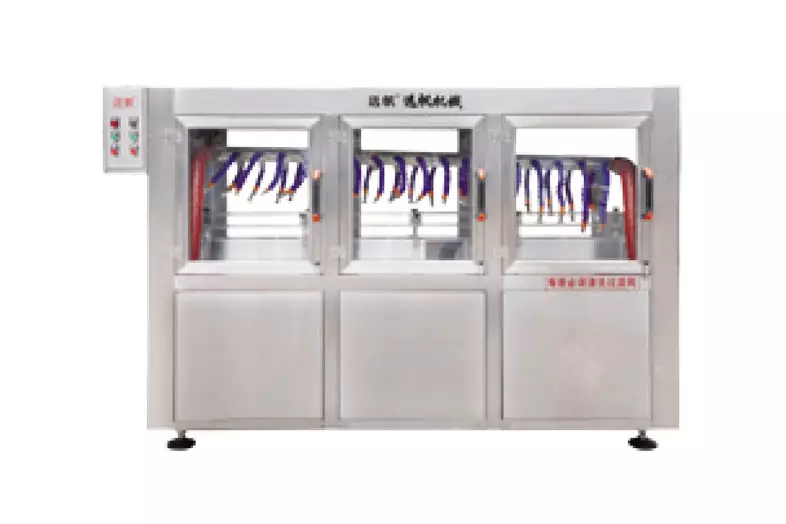
The HG-A/HG-B spider-arm dryer is intended for lines where fixed blowing points cannot consistently reach shoulders, waists, recessed panels or other changing bottle contours. Its swinging arms follow the bottle surface more closely, so selection should be based on actual container geometry and changeover conditions rather than published capacity alone.
The spider-arm arrangement moves the blowing points around the passing container instead of relying on one fixed air curtain. This can improve coverage around neck transitions, shoulders, handles, waists and recessed faces on complex bottles. The result still depends on bottle stability, spacing, line speed and where water remains after rinsing, so the target should be a defined residual-water condition rather than an unqualified promise of complete drying.
During a format change, verify arm position and travel, bottle guides, conveyor width and clearances to caps, neck rings, handles and guards. Include the most difficult bottle shape in the trial, because a setting accepted for a round bottle may not cover another format or remain mechanically clear.
| Model | Production capacity (bottles/hour) | Total power (kW) | Applicable bottle type | Dimensions |
|---|---|---|---|---|
| HG-A | 6000 | 5.5 | Φ=40-100mm H=100-380mm | 2000×850×1700 |
| HG-B | 9000 | 7.5 | Φ=40-100mm H=100-380mm | 2440×850×1700 |
Recommended next step
Compare the right capacity, confirm the raw-material process and request a factory configuration before ordering.
Match cleaning, crushing, roasting, pressing, filtering and filling equipment.
Open pageReview preparation and pressing routes for seeds, nuts and specialty materials.
Open pageCompare price, capacity, process, operation and startup requirements.
Open pageSend the material, target output and destination for a matched factory quote.
Request quoteReview additional machine, process and buyer resources on hydraulic-oil-press.com.
Open website