Plan a complete production line
Match cleaning, crushing, roasting, pressing, filtering and filling equipment.
Open page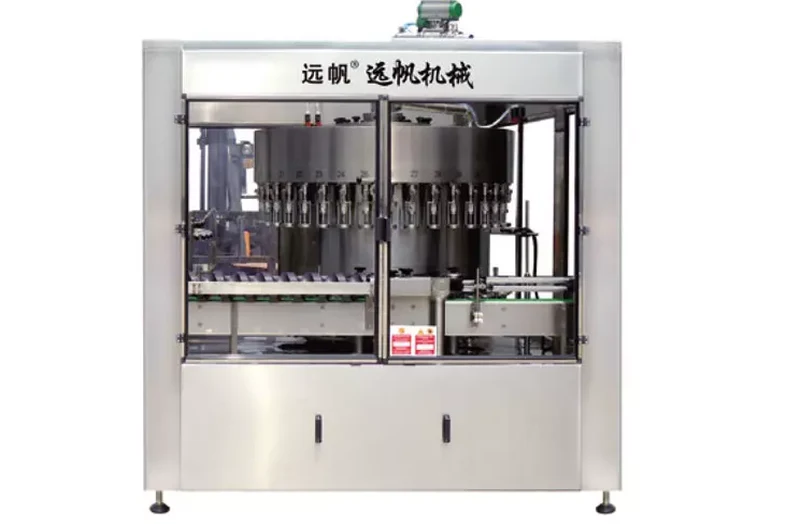
GFP-60H is the largest published model in this GFP group, with 60 heads, a 20,000 bottles/hour reference, 7.5 kW power and 3500 x 3500 x 2200 mm dimensions. A project at this scale should be purchased as an engineered line package with documented interfaces and acceptance assumptions, not as a stand-alone capacity claim.
Low-vacuum constant-level filling meters to a visible level rather than to mass. The published 20,000 bottles/hour figure is a reference condition, not a guaranteed complete-line result.
The table is retained exactly as published. Final compatibility, sustained output and supplied components must be stated in the technical quotation and acceptance protocol.
| Project | Parameters |
|---|---|
| Model | GFP-60H |
| Number of filling heads | 60 |
| Reference output | 20,000 bottles/hour |
| Total power | 7.5 kW |
| Overall dimensions | 3500×3500×2200 mm |
| Filling method | Low vacuum/constant level filling |
| Applicable liquids | Wine, rice wine, soy sauce, vinegar and other easily foaming liquids |
A 60-head low-vacuum filler should enter design only after the container and recipe pass an application review. The package needs a stable rigid neck and body; the liquid must be non-carbonated and able to achieve the specified visible level under tested temperature and foam conditions. Product names in the table are illustrative selection references.
Counter-pressure duty, particles or pulp, extreme viscosity, flexible packs and quantity control by weight require another technical route. Resolve those questions before civil work or downstream equipment is sized.
Neither 60 heads nor 20,000 bottles/hour proves sustained accepted production. Availability, product supply, closures, inspection and packing all contribute to the contractual result.
The 60H controls and accumulation study should cover product shortage, bottle shortage, downstream blockage, closure supply loss and emergency recovery. Assign ownership for integration testing across all machine suppliers.
Create a full integration register for the 60H project. It should assign process tank and filtration, feed and return behavior, utilities, drainage, rinser transfer, conveyor controls, closure supply, inspection, coding, case packing, palletizing and plant data exchange. Include foundation information, service clearances and installation sequencing.
Cleaning and format strategy must be engineered for the operating calendar. Specify product recovery, circuit isolation, wetted materials, seal sets, verification samples, change-part handling and the work allowed during planned stops.
Invite a manufacturer proposal only after issuing the production matrix: recipes, viscosity and temperature boundaries, bottles and neck finishes, target levels, closures, accepted output by SKU, shift plan, planned micro-stops, pack formats, line layout, utility schedule, control architecture, destination, documentation, installation division and spare-parts policy.
Use a contract-defined run duration with enough bottles, liquid, closures and packaging materials to test the complete line. SAT should repeat the critical cases under site utilities and operators, with open items tracked to written closure.
The acceptance plan needs a contract-defined continuous run with sufficient liquid, bottles, closures and packing material. Measure conforming finished packs, utility stability, stop recovery and interface faults. SAT should repeat the site-dependent scenarios with trained operators, and every remaining item should have an owner and written closeout rule.
A project of this scale needs schedules for equipment, engineering and lifecycle support. Record component makes, documentation, safety scope, FAT resources, export packing, freight basis, installation supervision, commissioning, training, warranty clauses, commissioning stock, wear-part prices and response channels. Marketing text is not a substitute for those schedules.
Request an engineered GFP-60H line proposal. Submit the production matrix and utility plan through the factory quotation form.
Recommended next step
Compare the right capacity, confirm the raw-material process and request a factory configuration before ordering.
Match cleaning, crushing, roasting, pressing, filtering and filling equipment.
Open pageReview preparation and pressing routes for seeds, nuts and specialty materials.
Open pageCompare price, capacity, process, operation and startup requirements.
Open pageSend the material, target output and destination for a matched factory quote.
Request quoteReview additional machine, process and buyer resources on hydraulic-oil-press.com.
Open website