Plan a complete production line
Match cleaning, crushing, roasting, pressing, filtering and filling equipment.
Open page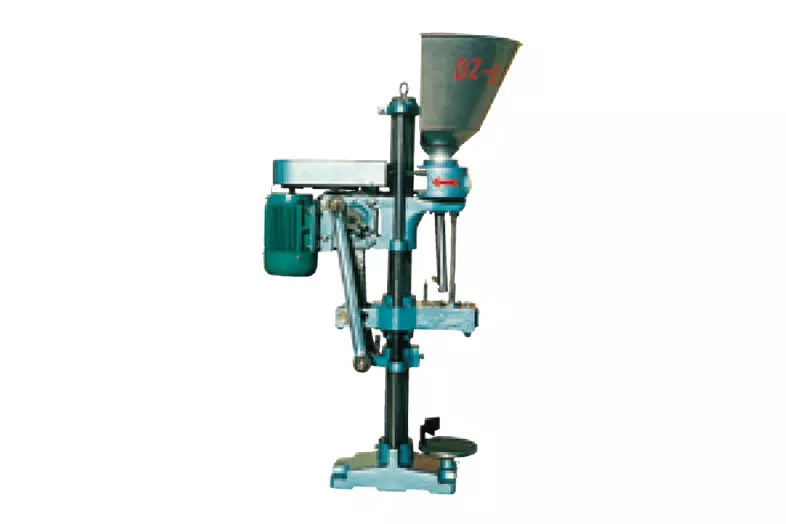
A semi-automatic corker sits between a hand-operated station and a continuous line. It is suited to small and medium batches when the buyer wants a repeatable machine press cycle but can still assign an operator to bottle handling. The term "semi-automatic" is not enough to define cork feeding or conveyors, so those items need an explicit boundary in the manufacturer quotation.
Use this operating split unless the offered configuration proves a different one:
The workstation is organized around repeated single-bottle cycles: collect from the filler buffer, position, present the cork, trigger the machine, remove, inspect and stage for the next operation. Output is limited by this complete loop and by operator coverage, not just press travel. For shift planning, ask for a sample trial and record whether one operator can also replenish corks and move bottles without creating an unsafe or unstable queue.
Supply actual bottles and corks for confirmation. Check bottle height, base and neck geometry against cork type, diameter and length. For each SKU, identify the settings or parts used for bottle support, neck alignment, insertion depth and cork presentation. Ask the supplier to demonstrate the format change rather than quoting a generic compatibility claim.
Because the pressing cycle is machine-assisted, the offered utility requirement matters. Confirm voltage, phase and frequency and whether compressed air or another service is required; request consumption and connection details for the actual configuration.
The table remains the published DS-series reference. It is not proof that the semi-automatic station includes these heads, power values or hourly outputs; reconcile every selected value with the signed quotation.
| Model | DS-1 | DS-4 | DS-6 |
|---|---|---|---|
| Number of plugging heads | 1 | 4 | 6 |
| Production capacity (bottles/hour) | 2500 | 4500 | 6000 |
| Complete machine power (kw) | 1.5 | 3 | 3 |
A semi-automatic station can be located after a filler without being mechanically synchronized to it. Plan an upstream buffer that protects filled bottles and gives the operator a manageable pickup point, plus an outfeed table, rack or quoted conveyor before cap shrinking. If conveyors are required, define direction, transfer height, bottle spacing, sensors and who supplies controls. The cap-shrinking step should begin only after the cork is seated to the agreed condition.
The layout also needs the operator position, loading and unloading reach, cork storage, guarding clearance, maintenance access and utility points. This is the information the supplier needs to price a usable station rather than a bare machine.
Separate the base machine price from cork-feed options, bottle fixtures and format parts, stands or conveyors, guarding, controls, spare parts, documentation, export packing, commissioning, training and after-sales support. State freight, site work and upstream or downstream equipment as inclusions or exclusions.
For FAT, run the agreed bottle-and-cork samples through repeated operator-loaded cycles. Record cork presentation method, seating condition, cycle initiation, guarding behavior, format adjustment and recovery after a normal stop. At SAT, verify the installed utilities, operator workflow, upstream buffer and downstream handoff. Any output test needs a jointly agreed format, staffing level, duration and acceptance rule; the public table alone is not an SAT criterion.
Recommended next step
Compare the right capacity, confirm the raw-material process and request a factory configuration before ordering.
Match cleaning, crushing, roasting, pressing, filtering and filling equipment.
Open pageReview preparation and pressing routes for seeds, nuts and specialty materials.
Open pageCompare price, capacity, process, operation and startup requirements.
Open pageSend the material, target output and destination for a matched factory quote.
Request quoteReview additional machine, process and buyer resources on hydraulic-oil-press.com.
Open website