Plan a complete production line
Match cleaning, crushing, roasting, pressing, filtering and filling equipment.
Open page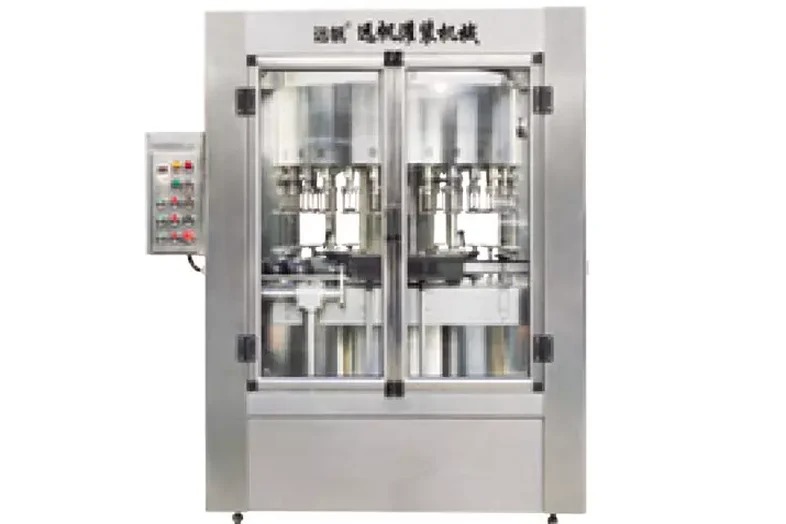
GFP-36H is listed with 36 heads, 10,000 bottles/hour reference output, 3 kW power and dimensions of 2500 x 2350 x 2200 mm. At this line class, utilities, accumulation and recovery from brief stops can influence accepted output as much as the filling carousel itself.
Low-vacuum constant-level filling meters to a visible level rather than to mass. The published 10,000 bottles/hour figure is a reference condition, not a guaranteed complete-line result.
The table is retained exactly as published. Final compatibility, sustained output and supplied components must be stated in the technical quotation and acceptance protocol.
| Project | Parameters |
|---|---|
| Model | GFP-36H |
| Number of filling heads | 36 |
| Reference output | 10,000 bottles/hour |
| Total power | 3 kW |
| Dimensions | 2500×2350×2200 mm |
| Filling method | Low vacuum/constant level filling |
| Applicable liquids | Wine, rice wine, soy sauce, vinegar and other easily foaming liquids |
Low-vacuum constant-level filling depends on a repeatable seal at a rigid bottle neck and on a still liquid that can circulate without unacceptable foam. Test the production recipe at normal and boundary temperatures. Wine, rice wine, vinegar, soy sauce and comparable non-carbonated liquids can enter the evaluation, but suitability remains tied to the supplied samples.
Sparkling liquids, products with suspended solids, paste-like viscosity, collapsible containers and legal quantity control by mass fall outside the normal selection basis. They should trigger a review of counter-pressure, large-port, positive-displacement or weighing equipment as appropriate.
The 36-head count and 10,000-bottle reference are published selection data, not evidence of line availability, product accuracy or container-loss performance.
For a 10,000 bottles/hour reference project, define upstream product availability and downstream accumulation in minutes or bottle count. The controls should exchange ready, run, fault and blocked/starved states with adjoining equipment.
At this reference rate, issue a responsibility matrix for process supply, bottle handling and controls. Specify product feed stability, return and drain points; rinser discharge and conveyor elevation; closure, inspection and labeling readiness; accumulation measured in bottles; and blocked/starved communication. Include utility connection loads in the interface register.
Cleaning must be designed around the actual recipe sequence. Obtain wetted-part materials, elastomer compatibility, circuit volume, low points, dismantling tools and the boundary of any circulation cleaning. Define format storage and verification after reassembly.
A 36H quotation package should include representative liquid and bottles, viscosity and temperature bands, foam observation, target level, neck finish, closure, required accepted rate, accumulation strategy, plant layout, utility quality, controls protocol, country of installation, documentation language and the requested site-service tasks.
Include planned starved and blocked conditions in the acceptance run. Confirm that restart does not create an unagreed wave of underfilled, overfilled or foaming bottles, and define how those bottles are identified.
Introduce controlled starved and blocked states during FAT, then measure recovery as well as steady running. State how many acceptable bottles must be produced, the observation interval, allowed level range, foam or overflow limit and reject classification. Repeat critical interface cases during SAT with the actual site utilities.
Ask the manufacturer to identify the exact commercial boundary around the filler. Product tank, vacuum equipment, conveyors, control integration, safety systems, FAT materials, export packing, installation, commissioning, training, warranty, critical spares and later support should each show inclusion, exclusion, price and lead time.
Plan the GFP-36H interfaces before purchase. Send the line layout and utility schedule with your manufacturer quote request.
Recommended next step
Compare the right capacity, confirm the raw-material process and request a factory configuration before ordering.
Match cleaning, crushing, roasting, pressing, filtering and filling equipment.
Open pageReview preparation and pressing routes for seeds, nuts and specialty materials.
Open pageCompare price, capacity, process, operation and startup requirements.
Open pageSend the material, target output and destination for a matched factory quote.
Request quoteReview additional machine, process and buyer resources on hydraulic-oil-press.com.
Open website