Plan a complete production line
Match cleaning, crushing, roasting, pressing, filtering and filling equipment.
Open page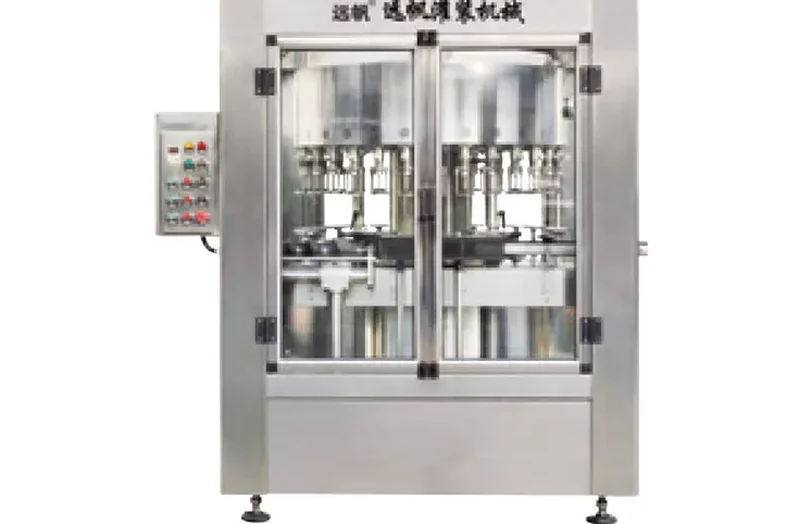
GFP-40H combines 40 published heads with a 12,000 bottles/hour reference, 3.7 kW power and a 2500 x 2500 x 2200 mm overall envelope. The nearly square footprint can simplify some layouts, but it also makes service clearance and conveyor approach angles part of the purchasing decision.
Low-vacuum constant-level filling meters to a visible level rather than to mass. The published 12,000 bottles/hour figure is a reference condition, not a guaranteed complete-line result.
The table is retained exactly as published. Final compatibility, sustained output and supplied components must be stated in the technical quotation and acceptance protocol.
| Project | Parameters |
|---|---|
| Model | GFP-40H |
| Number of filling heads | 40 |
| Reference production | 12,000 bottles/hour |
| Total power | 3.7 kW |
| Overall dimensions | 2500×2500×2200 mm |
| Filling method | Low vacuum/constant level filling |
| Applicable liquids | Wine, rice wine, soy sauce, vinegar and other easily foaming liquids |
GFP-40H uses a level-based low-vacuum concept. Its normal candidate is a firm bottle whose finish can be presented consistently to the valve, filled with a non-sparkling liquid that remains sufficiently fluid. If the recipe tends to foam, test the final formulation and temperature rather than a water-only substitute.
Do not assume compatibility with carbonated drinks, liquids containing pulp or other solids, very thick media, soft packages or net-weight dosing. A separate filling principle and sample study are needed for those conditions.
Forty stations and the public reference output do not establish maintenance simplicity, bottle protection or achieved accuracy. These belong in drawings, operating procedures and acceptance records.
The 40H interface drawing should resolve conveyor elevation, infeed pressure, discharge spacing and the physical route to closure and labeling. Where floor space is tight, include maintenance removal paths before civil work begins.
Use the nearly square published footprint to review real access, not just machine placement. Draw guard opening, cabinet access, product and vacuum connections, conveyor approach angles and the path for removing format parts. Coordinate the discharge with closure, inspection and labeling controls, including accumulation and fault recovery.
The purchase file should define bottle-format identification, baseline settings and first-piece approval after changeover. For sanitation, specify product-contact surfaces, seal materials, drain sequence, removed parts, wash method and who supplies cleaning skids or chemicals.
To price GFP-40H correctly, provide liquid composition and operating range, foam and cleaning data, bottle samples with dimensioned finishes, target level, closure details, accepted throughput by SKU, floor plan, upstream and downstream machine information, electrical standard, available services, destination and the desired field-support package.
Use the FAT to validate both normal production and a documented format change. Record the parts changed, settings used, elapsed time and first acceptable bottle after restart without turning that observation into a universal changeover guarantee.
Make one documented format change part of FAT. Record the pieces exchanged, settings, sanitation steps, elapsed observation and first conforming bottles, while avoiding a universal changeover promise. The production run also needs written level, foam, reject and stop-restart criteria; SAT verifies installation-dependent items.
The factory quotation should distinguish standard equipment from project options. Require separate lines for bottle parts, product connections, controls, guarding, conveyors, drawings, certificates actually requested, packing, delivery, installation, commissioning, training, warranty, recommended inventory and after-sales response.
Check the 40H layout and format scope. Send dimensioned bottles and the plant drawing through the quotation channel.
Recommended next step
Compare the right capacity, confirm the raw-material process and request a factory configuration before ordering.
Match cleaning, crushing, roasting, pressing, filtering and filling equipment.
Open pageReview preparation and pressing routes for seeds, nuts and specialty materials.
Open pageCompare price, capacity, process, operation and startup requirements.
Open pageSend the material, target output and destination for a matched factory quote.
Request quoteReview additional machine, process and buyer resources on hydraulic-oil-press.com.
Open website