Plan a complete production line
Match cleaning, crushing, roasting, pressing, filtering and filling equipment.
Open page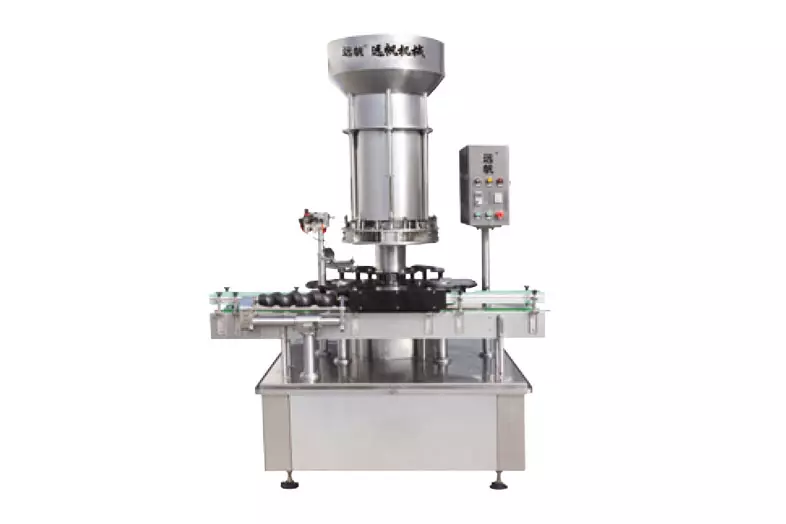
An automatic corker is the line-level option in this series. Filled glass bottles arrive from upstream, corking is organized as a continuous machine cycle, and closed bottles leave toward the next packaging step. The public information places the machine after filling and identifies DS-1, DS-4 and DS-6 as reference models, so selection should cover the whole transfer path rather than head count alone.
For a project to be quoted as fully automatic, the supplier should define all four movements: receiving bottles, presenting corks, completing the pressing cycle, and discharging corked bottles.
The effective line rhythm is set by the slowest connected operation, not by the corker in isolation. Filling discharge, bottle accumulation, cork replenishment, the corking cycle and cap-shrinking or labeling infeed all need compatible flow. Ask the manufacturer to state the conditions behind any quoted output and how the line responds to no bottle, no cork, upstream stop and downstream backup. These control functions must be confirmed in the quotation rather than inferred from the word "automatic."
Provide production bottles and corks before final selection. The sample set should represent bottle height, base stability, neck finish and internal neck opening, together with cork type, diameter and length. For several SKUs, send a format matrix and ask which guides, transfer parts, cork-feed parts or head settings change. The supplier should list included change parts, adjustment method and the changeover demonstration planned for acceptance testing.
The public table below is retained as a DS-series reference. It does not by itself define the accepted bottle and cork range, the included feeding and conveyor equipment, or guaranteed output after line integration.
| Model | DS-1 | DS-4 | DS-6 |
|---|---|---|---|
| Number of plugging heads | 1 | 4 | 6 |
| Production capacity (bottles/hour) | 2500 | 4500 | 6000 |
| Complete machine power (kw) | 1.5 | 3 | 3 |
Request a general-arrangement drawing showing infeed and outfeed direction and height, guarding and door access, cork replenishment position, maintenance clearance, control-cabinet access and the required bottle buffers. The filler-to-corker boundary must identify the physical transfer and any exchanged run, ready, stop or fault signals. The downstream cap-shrinking machine should receive a stable bottle with the cork seated to the agreed position; direct synchronization is not included unless the quotation says so.
Confirm site voltage, phase and frequency, plus compressed air, vacuum or other utilities only where the offered design requires them. The manufacturer quote should give connection points and consumption instead of leaving the buyer to assume them.
A comparable purchase quotation should separate the base corker from cork handling, conveyors, bottle guides and change parts, guards and controls, initial spares, manuals, export packing, commissioning, training and after-sales support. It should also list exclusions, delivery boundary and the equipment supplied by others.
For FAT, agree the sample bottles and corks, formats to run, test duration, observations and pass criteria before the order is released. Check continuous transfer, cork presentation, seating result, planned stops and restart behavior without converting the public table into an unqualified guarantee. SAT should repeat the agreed checks after installation with actual utilities and the connected filler and downstream equipment, and should record remaining interface actions.
Recommended next step
Compare the right capacity, confirm the raw-material process and request a factory configuration before ordering.
Match cleaning, crushing, roasting, pressing, filtering and filling equipment.
Open pageReview preparation and pressing routes for seeds, nuts and specialty materials.
Open pageCompare price, capacity, process, operation and startup requirements.
Open pageSend the material, target output and destination for a matched factory quote.
Request quoteReview additional machine, process and buyer resources on hydraulic-oil-press.com.
Open website