Plan a complete production line
Match cleaning, crushing, roasting, pressing, filtering and filling equipment.
Open page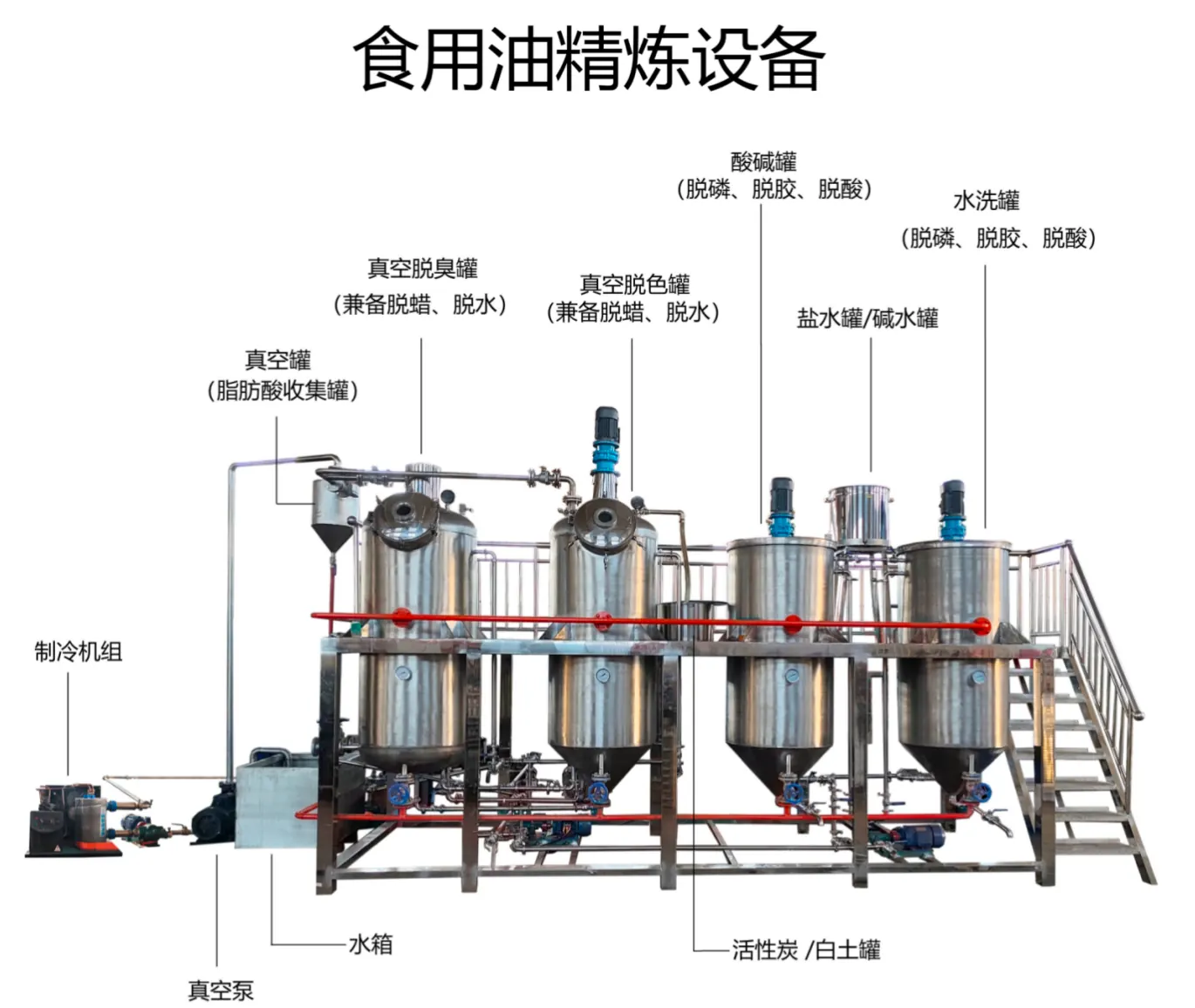
The purpose of refining is to remove impurities from crude oil and improve the quality and stability of the oil.
Based on reaction mechanisms and process characteristics, the methods used for oil refining can be broadly divided into mechanical methods, chemical methods, and physicochemical methods. Common mechanical methods include sedimentation, filtration, and centrifugal separation; common chemical methods include acid refining, alkali neutralization, oxidation-reduction, and esterification; common physicochemical methods include hydration, adsorption, steam distillation, liquid-liquid extraction, and freezing crystallization.
Oil refining is a relatively complex and flexible process. In a certain refining step, several different methods may be combined to complete the process. For example, alkali refining and deacidification utilize the neutralization reaction between alkali solution and free fatty acids in crude oil to remove free fatty acids from crude oil, which is a typical chemical method. However, the soapstock formed after neutralization and reaction can adsorb other impurities and pigments in crude oil, which is a typical physicochemical method. In addition, the oil-soap two phases generated in the process are generally separated by gravity sedimentation or centrifugal separation, which is a typical mechanical method. Therefore, various refining processes cannot be completely separated, and only a scientific and effective combination of various methods can improve refining efficiency and achieve the purpose of refining.
Recommended next step
Compare the right capacity, confirm the raw-material process and request a factory configuration before ordering.
Match cleaning, crushing, roasting, pressing, filtering and filling equipment.
Open pageReview preparation and pressing routes for seeds, nuts and specialty materials.
Open pageCompare price, capacity, process, operation and startup requirements.
Open pageSend the material, target output and destination for a matched factory quote.
Request quoteReview additional machine, process and buyer resources on hydraulic-oil-press.com.
Open website