Plan a complete production line
Match cleaning, crushing, roasting, pressing, filtering and filling equipment.
Open page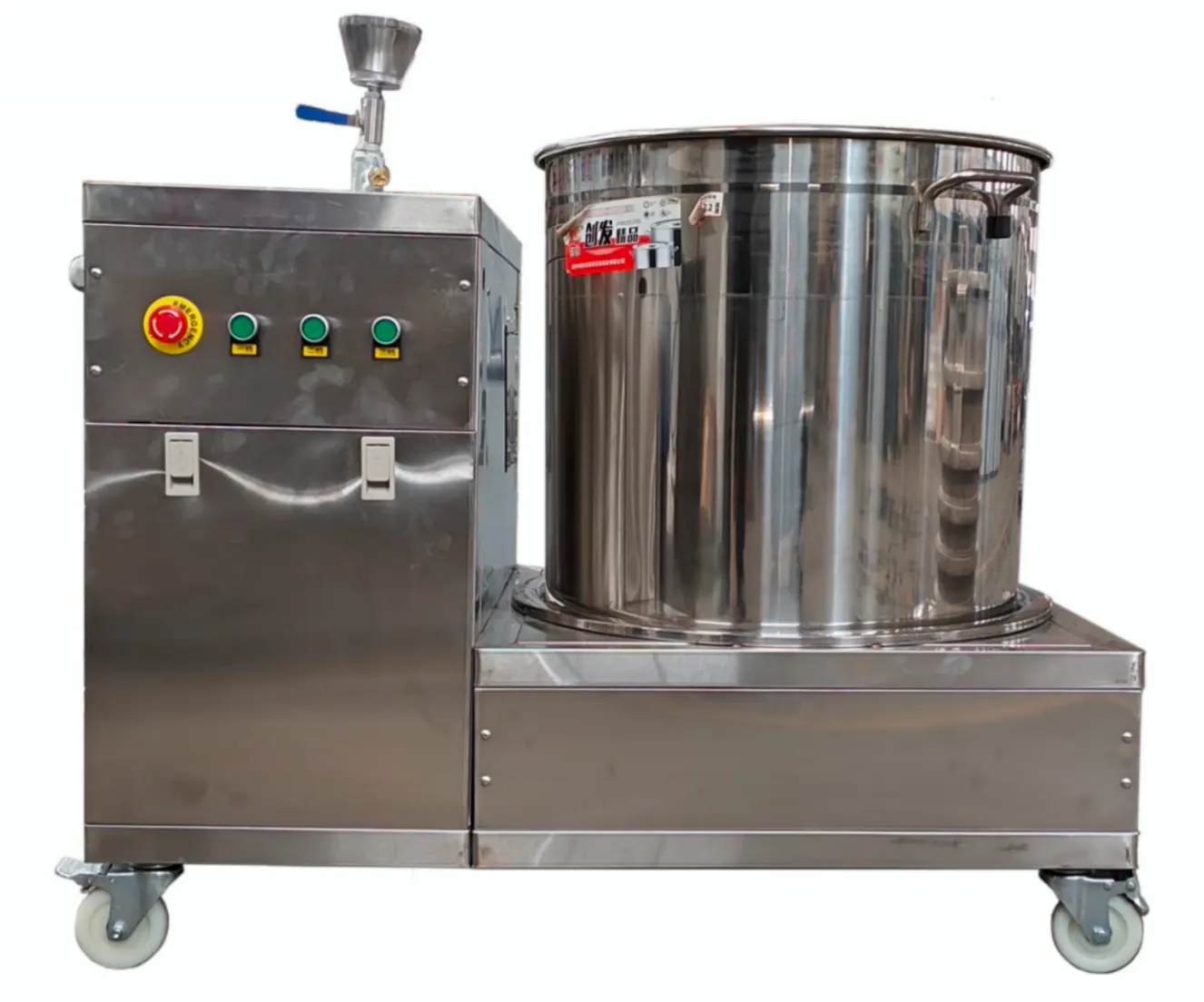
This electric steamer is a batch thermal-conditioning unit for oilseed preparation. Its normal role is ahead of the 300 and 325 hydraulic hot presses, where the buyer needs controlled steam and heat treatment before pressing. It is not a default item for the 355–500 direct cold-press route because intentional heating may conflict with the agreed cold-process temperature limit.
The required endpoint must be defined by the raw material rather than by a universal cycle time. The technical agreement should state the seed or kernel, load, starting temperature and moisture, target temperature, moisture or tactile condition, sampling points, discharge endpoint, cycle definition, and acceptance tolerance.
The product description identifies a heated main water tank and an auxiliary negative-pressure feed tank, with separate heating and water-supply functions. It also identifies 304 stainless steel for the water tanks and connecting pipes or fittings, while the public table separately lists the steamer material. The quotation must therefore include a component-level material schedule, thickness where required, seals, valves, float assembly, drains, and all wetted parts; these should not be treated as one undifferentiated material claim.
The water-electric separation layout, three heating levels, emergency stop, inspection opening, split pot, drains, and float access are configuration points to verify. Electrical safety still depends on the contracted voltage, protective devices, grounding, installation, water quality, inspection, and local operating procedure.
| Parameter | Value |
|---|---|
| Total Height | 1550mm |
| Pot Depth | 600mm |
| Pot Body Diameter | 600mm |
| Max Processing Capacity | 100Kg |
| Total Power | 27kW |
| Heating Power | 9/18/27kW |
| Weight | Approx. 54Kg |
| Equipment Dimensions | 1105x700x1080mm |
| Steamer Material | 201 Stainless Steel |
The maximum-processing-capacity entry in the table is a supplier reference under its source conditions, not a promise for every oilseed or fill level. Any contracted batch mass and cycle must be verified with the agreed material, loading method, starting state, target endpoint, site voltage, water conditions, test duration, and acceptance tolerance. No fixed steaming-and-discharge time is guaranteed on this page.
Provide the raw material, particle form, shell or kernel content, batch mass range, starting moisture and temperature, target condition before pressing, planned batches per shift, cleaning frequency, and sample quantity. Identify whether the steamer will feed the 300 or 325 press, the transfer height and container, and the maximum permitted delay between discharge and pressing.
The manufacturer also needs the site voltage and frequency, available electrical capacity, water source and quality, make-up pressure, drainage, ventilation or steam-management plan, ambient conditions, floor and access dimensions, and local safety requirements before issuing a firm configuration and price.
The offer should itemize the pot, main and auxiliary tanks, heaters, controls, emergency stop, float and feed components, connecting pipes, valves, drains, seals, guards, cables, tools, documents, and any frame or transfer aid. It should separately state whether the buyer supplies the breaker, incoming cable, grounding, water treatment, external piping, floor drainage, ventilation, lifting, and connection to the press.
Recommended spares may include the quoted heating, seal, valve, float, and electrical items, but quantities and inclusion must be written into the order. Describing an access port or drain does not establish a maintenance interval or service-life guarantee.
FAT should first verify water filling, drainage, leakage, heating-level operation, emergency stop, protective earth, controls, float action, and access for inspection. A representative-material test should then record load, start and end conditions, cycle definition, readings at agreed sample points, discharge, retained material, and repeatability across the contracted number of batches.
SAT should verify the final power and water connections, drainage and steam handling, operator access, transfer to the 300 or 325 press, site interlocks, and the acceptance run stated in the contract. Any food-contact cleaning or local electrical inspection remains subject to the agreed responsibility matrix.
Purchase price depends on electrical execution, component materials, water circuit, controls, transfer aids, spares, export packing, documentation, FAT, installation, and commissioning. The quotation should state the warranty period and start point, wear and consumable exclusions, spare-part prices, remote support, site-service region, travel and accommodation costs, training, response process, and buyer responsibilities in writing.
Compare the 300 hydraulic hot press and 325 hydraulic hot press, then submit the material and utility data through the contact page for a manufacturer quotation.
Recommended next step
Compare the right capacity, confirm the raw-material process and request a factory configuration before ordering.
Match cleaning, crushing, roasting, pressing, filtering and filling equipment.
Open pageReview preparation and pressing routes for seeds, nuts and specialty materials.
Open pageCompare price, capacity, process, operation and startup requirements.
Open pageSend the material, target output and destination for a matched factory quote.
Request quoteReview additional machine, process and buyer resources on hydraulic-oil-press.com.
Open website