Plan a complete production line
Match cleaning, crushing, roasting, pressing, filtering and filling equipment.
Open page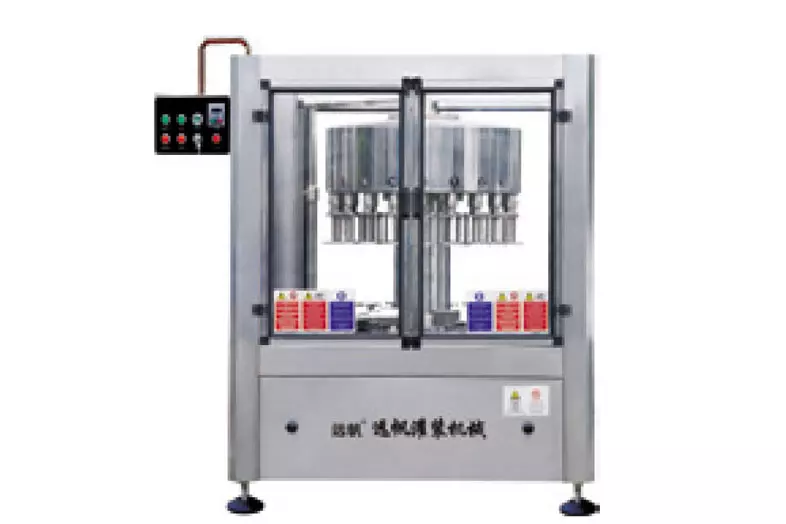
GFP-18A places 18 filling heads in a published 1500 x 1600 x 2200 mm envelope, with a 4,500 bottles/hour reference and 1.12 kW listed power. It can be considered when a 12-head layout is too limited but a larger rotary filler is not yet justified. The actual line rate still depends on bottle pitch, liquid behavior and the machines before and after the filler.
Low-vacuum constant-level filling meters to a visible level rather than to mass. The published 4,500 bottles/hour figure is a reference condition, not a guaranteed complete-line result.
The table is retained exactly as published. Final compatibility, sustained output and supplied components must be stated in the technical quotation and acceptance protocol.
| Project | Parameters |
|---|---|
| Model | GFP-18A |
| Number of filling heads | 18 |
| Reference production | 4500 bottles/hour |
| Total power | 1.12 kW |
| Overall dimensions | 1500×1600×2200 mm |
| Filling method | Low vacuum/constant level filling |
| Applicable liquids | Wine, rice wine, soy sauce, vinegar and other easily foaming liquids |
The GFP principle is intended for constant visible level in rigid containers. First prove that the neck can form the required valve contact and that the non-carbonated liquid flows consistently. Products such as still wine, rice wine, vinegar and soy sauce may be assessed, especially when foaming is a concern, but no product name replaces a trial.
Carbonated beverages require pressure-compatible filling. Fibers, pulp or particles can obstruct a level valve; unusually viscous products may need positive displacement; and a sales requirement stated in grams or kilograms points toward weighing. Route those cases to a different solution study.
Eighteen filling positions are one mechanical fact. Accepted throughput, container handling, level repeatability and sanitation time remain project-specific acceptance items.
At this scale, the infeed and discharge transfers deserve their own interface schedule. Define conveyor height, direction, accumulation philosophy, bottle-present signals and what happens when the closure machine stops.
Prepare an interface schedule for the rinser-to-filler and filler-to-closure transfers. Include conveyor centerline, height, bottle pitch, accumulation capacity, motor and sensor ownership, plus the sequence used when either adjacent machine is unavailable. Product feed stability and the return path must be assigned to a named supplier.
The change-part list should cover the widest and narrowest contract bottles. Cleaning documentation needs a product-contact drawing, gasket list, low-point drains, disassembly steps and the agreed boundary between automated circulation and manual work.
Ask for the GFP-18A factory price using a data pack: product recipe or safety information where relevant, operating viscosity and temperature, representative liquid, all container samples, neck and level drawings, closure details, accepted-rate target by format, proposed layout, utilities, destination, packing standard and expected installation support.
Use a timed production run long enough to expose recurring transfer or foam issues. The protocol should separate gross machine counts from accepted filled bottles and record the reason for every rejected or manually removed bottle.
A timed FAT should count accepted filled bottles rather than relying on the machine counter. Sample at defined intervals, log level variation and foam, identify every removed bottle and introduce at least one controlled upstream or downstream interruption. Site acceptance then checks the same interface logic with the installed line.
Configuration drives cost. The supplier should separate the filler, bottle sets, liquid system, vacuum items, conveyors, controls, guarding, documents and optional services. Delivery date, commissioning, training, warranty, recommended spares and support channels are valid only as stated in the signed commercial and technical documents.
Build an 18-head line quotation. Provide the rinser, closure and bottle information through the manufacturer inquiry page.
Recommended next step
Compare the right capacity, confirm the raw-material process and request a factory configuration before ordering.
Match cleaning, crushing, roasting, pressing, filtering and filling equipment.
Open pageReview preparation and pressing routes for seeds, nuts and specialty materials.
Open pageCompare price, capacity, process, operation and startup requirements.
Open pageSend the material, target output and destination for a matched factory quote.
Request quoteReview additional machine, process and buyer resources on hydraulic-oil-press.com.
Open website