Plan a complete production line
Match cleaning, crushing, roasting, pressing, filtering and filling equipment.
Open page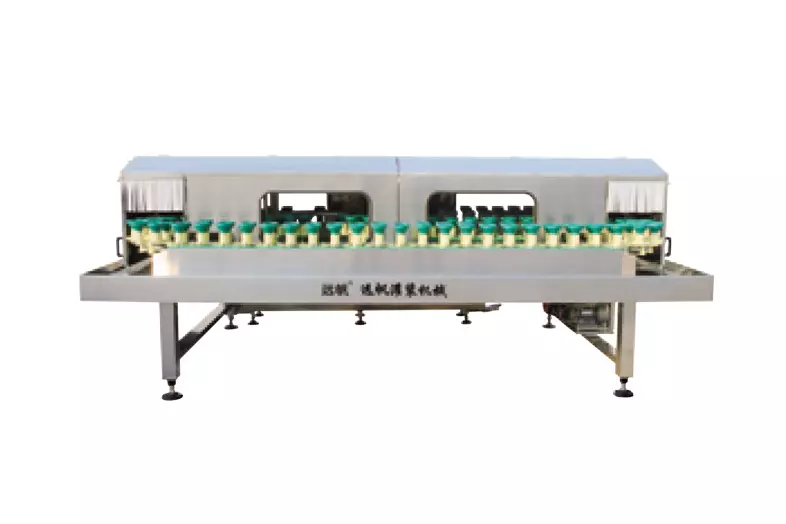
The six-wheel washer uses a sleeve roller chain to carry bottles through its rinse zones. Recirculated water is applied by both tracking sprays and fixed-pipe sprays, while the clean-water section uses a distributor that follows the bottle position. That combination, rather than the model code alone, distinguishes this family from a basic chain-rail washer and from the rotary QSP-6A.
The roller chain establishes bottle pitch through the machine. Tracking sprays must remain synchronized with that pitch; fixed piping covers a defined section of travel, and the clean-water distributor supplies the final tracking spray. A continuous chain path needs stable support and coordinated infeed and discharge so that bottles do not crowd at the entrance or accumulate at the exit.
The source does not define inversion, brushes, nozzle count, or a cleaning-result class. It also does not say which tanks, pumps, filters, make-up controls, overflow, blowdown, and connecting pipes are included. The water-system boundary therefore has to be itemized even though recirculated and clean-water stages are both described.
| Model | QSP-6A | QSP-6B |
|---|---|---|
| Production Capacity | 3000-6000 bottles/hour | 3000-7000 bottles/hour |
| Applicable bottle type | ∅=50-100mm H=100-320mm | |
| Complete machine power | 1.85kw | 2.2kw |
| Dimensions | 3200×1650×1500mm | 3688×2025×1500mm |
The table covers glass or PET bottles from 50-100 mm in diameter and 100-320 mm in height. Bottles within that envelope can still differ in shoulder profile, base geometry, stiffness, and center of gravity, requiring dedicated guides or supports. Lightweight PET should be trialled to confirm that bottle handling and spray force do not destabilize it.
The buyer provides each sample format and target rate. The manufacturer identifies chain or carrier parts, guides, and tracking-spray adjustments, then states which bottles are assigned to QSP-6A or QSP-6B. Since the rotary product also uses QSP-6A, the order must include the full machine name, capacity range, power, and dimensions.
Upstream equipment should deliver an orderly stream of empty bottles; downstream equipment should accept wet bottles and provide drainage or air drying as required. The layout confirms conveyor height and direction, chain-speed reference, interlocks, accumulation, maintenance side, piping, and floor drains. Service and changeover clearance is additional to the dimensions in the table.
No water consumption, inlet pressure, or connection size is published here. The buyer supplies clean water, any required recirculation make-up, power, and external drainage to the final utility schedule. For hot water, detergent, or disinfectant, the buyer provides medium composition, concentration, temperature, safety data, and discharge rules; the manufacturer reviews wetted-part compatibility. Media preparation and wastewater treatment are included only when quoted.
QSP-6A and QSP-6B cannot be priced from output alone. Bottle parts, tracking-spray execution, water-system scope, controls, adjacent conveyors, spares, export packing, installation, and commissioning all affect the purchase price. The offer should list the main machine, format parts, distributors and water circuit, controls, tools, documentation, FAT, packing, and buyer-supplied items.
FAT should run representative glass and/or PET samples and check chain motion, bottle synchronization, recirculated-water tracking spray, fixed-pipe spray, clean-water tracking spray, changeover, and contracted rate. SAT verifies actual bottle flow, site water and drainage, line signals, and sustained operation. If cleaning performance is to be quantified, the contamination sample and inspection method must be agreed before testing rather than replaced by an unsupported cleanliness claim.
After-sales terms should define warranty duration and start, treatment of chains, carriers, nozzles, and seals as wear parts, remote assistance, site-service and travel charges, spares, and training. Responsibility for unsuitable water, chemicals, incorrect changeover, or external conveyor faults should also be written into the contract.
Compare the mechanisms in the bottle-washing range and use the full equipment parameter library for line selection. Integration references are available in the filling-package overview and production-line overview; submit the RFQ through the contact page.
Recommended next step
Compare the right capacity, confirm the raw-material process and request a factory configuration before ordering.
Match cleaning, crushing, roasting, pressing, filtering and filling equipment.
Open pageReview preparation and pressing routes for seeds, nuts and specialty materials.
Open pageCompare price, capacity, process, operation and startup requirements.
Open pageSend the material, target output and destination for a matched factory quote.
Request quoteReview additional machine, process and buyer resources on hydraulic-oil-press.com.
Open website