Plan a complete production line
Match cleaning, crushing, roasting, pressing, filtering and filling equipment.
Open page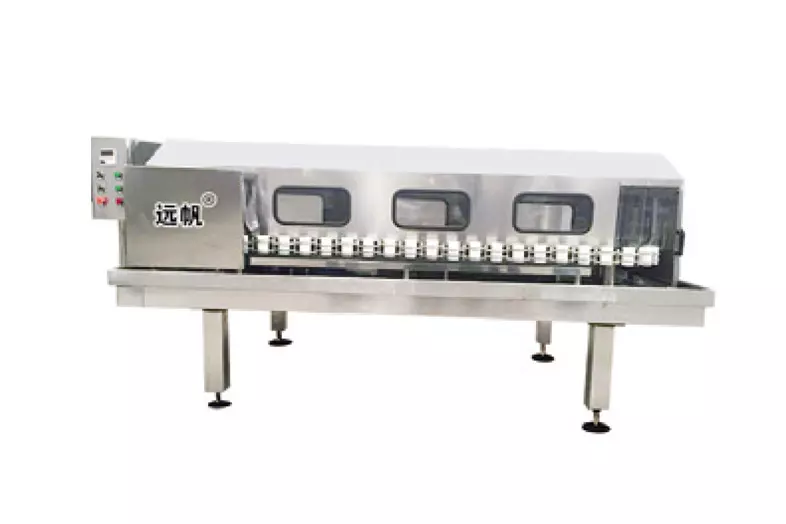
The source description for the rotary QSP-6A gives a specific water sequence: front-side bottle loading and unloading, a six-wheel drive, three water distributors, a recirculation tank and pump, two recirculated-water rinses, and one clean-water final rinse. Drive speed is steplessly adjustable. In this description, "six-wheel drive" is a feature of the rotary machine and must not be confused with the separate six-wheel washer family.
Bottles move through the recirculated-water and clean-water positions in the machine's rotary rhythm, so infeed transfer, internal movement, and discharge must remain synchronized. Recirculated water serves the first two rinses and clean water the last. The source does not specify filtration grade, make-up control, blowdown interval, nozzle count, bottle inversion, brushes, or chemical dosing. Those items exist only if they appear in the accepted quotation and water schematic.
The table supports initial selection of regular bottles. Irregular containers, lightweight PET, or bottles with an offset center of gravity require sample testing because rotary transfer is sensitive to repeatable bottle positioning.
| Model | Maximum output (b/h) | Complete machine power (kw) | Applicable bottle type (mm) | Water consumption (m³/h) | Flushing pressure | Dimensions (mm) | |
|---|---|---|---|---|---|---|---|
| diameter | height | ||||||
| QSP-6A | 6000 | 1.85 | ∅40-∅110 | 120-320 | 1.5 | 0.1-0.25 | 2950×1650×1550 |
The buyer supplies physical samples for every bottle family, including dimensional extremes and the lightest or least stable format. The manufacturer uses them to confirm guides, transfer parts, pitch, operating range, and changeover steps. Because QSP-6A also appears in the six-wheel washer table, purchase documents should always state "rotary bottle rinser" together with this page's capacity, power, and dimensions instead of relying on the model code alone.
The upstream conveyor needs controlled bottle flow and appropriate accumulation. Downstream equipment must receive bottles after the clean-water rinse and provide any required drainage, air drying, filling, capping, or labeling. Conveyor elevation, direction, speed reference, interlocks, and jam handling are set in the approved line layout.
The table lists 1.5 m3/h water consumption and a rinse-pressure value of 0.1-0.25, but no pressure unit is shown. The quotation must add the unit, measurement point, and permitted variation. The buyer supplies clean water of the agreed quality and pressure, power, and external drainage to the defined boundary.
Although the source expressly mentions the recirculation tank and pump, the status of filters, make-up valve, overflow, blowdown, and wastewater treatment must still be itemized. If hot water, detergent, or disinfectant will be used in either circuit, the buyer provides composition, concentration, temperature, safety data, and discharge conditions; the manufacturer reviews wetted materials and seals before approval.
The published footprint excludes service access to the tank, pump, drive, and controls, as well as conveyor transitions and floor drainage. Final placement follows an agreed interface drawing.
There is no fixed purchase price. The offer should identify the rotary QSP-6A main unit, three distributors, recirculation tank, pump, bottle parts, controls, interfaces, spares, and packing, then separately state water treatment, external conveyors, installation materials, freight, commissioning, training, and travel. Bottle count, electrical standard, line interfaces, and service location can all change the price.
FAT should verify sample transfer, the two recirculated-water rinses followed by the clean-water rinse, speed adjustment, drainage, changeover, and contracted output. It should also close the missing pressure unit and record test-water conditions. SAT checks the actual site water, line signals, interfaces, and sustained operation after utilities and adjacent equipment are ready.
Warranty start and duration, pump and seal wear items, remote support, field-service charges, travel, spares, and response method belong in the contract. A general promise of service is not a substitute for executable terms.
Identify alternatives through the bottle-washing range, then review line context in the complete equipment parameter library. The filling-package overview and production-line overview cover integration; submit samples and RFQ details on the contact page.
Recommended next step
Compare the right capacity, confirm the raw-material process and request a factory configuration before ordering.
Match cleaning, crushing, roasting, pressing, filtering and filling equipment.
Open pageReview preparation and pressing routes for seeds, nuts and specialty materials.
Open pageCompare price, capacity, process, operation and startup requirements.
Open pageSend the material, target output and destination for a matched factory quote.
Request quoteReview additional machine, process and buyer resources on hydraulic-oil-press.com.
Open website