Plan a complete production line
Match cleaning, crushing, roasting, pressing, filtering and filling equipment.
Open page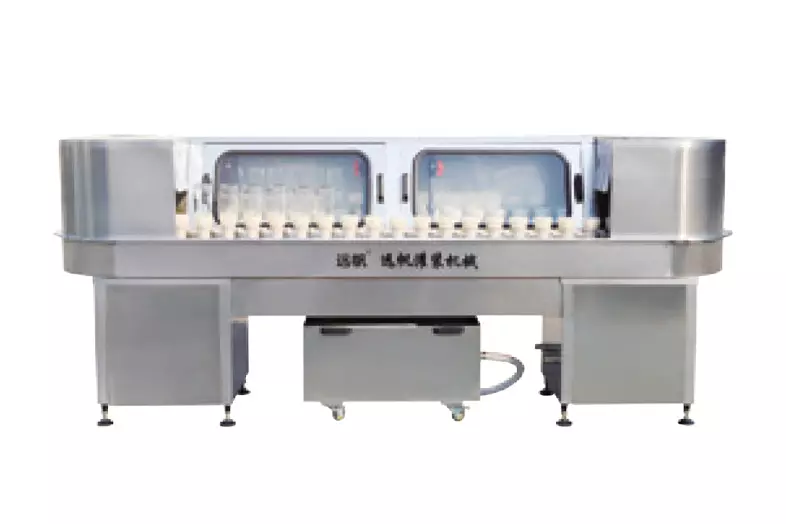
An intermittent rinser advances a group of bottles, stops them at the rinse positions, completes that part of the cycle, and then indexes the group onward. Its defining difference from a tracking or continuously moving rinser is this start-stop rhythm, not a general claim that it is always slower.
The table identifies QSP-3000, QSP-4500, and QSP-6000 models by rinse stations, maximum output, power, water demand, and footprint. Because bottles are released in cycles, upstream accumulation should prevent pressure building while the machine is stopped, and downstream equipment should accept a periodic discharge. A contractual throughput test needs a named bottle, cycle conditions, run duration, and counting rule.
The source says the machine can rinse new and returned bottles of different types and materials. It does not define inversion, brushes, soaking, number of rinse stages, heated water, or chemical treatment. Any such duty requires a separate process specification.
| Model | rinsing station | Maximum output (p/h) | Complete machine power (kw) | Applicable bottle type (mm) | Water consumption (m³/h) | Dimensions (mm) | |
|---|---|---|---|---|---|---|---|
| diameter | height | ||||||
| QSP-3000 | 6 | 3000 | 0.55 | ∅40-∅110 | 120-350 | 0.35 | 3000×700×1350 |
| QSP-4500 | 36 | 4500 | 1.85 | ∅40-∅110 | 120-350 | 0.75 | 3140×760×1350 |
| QSP-6000 | 48 | 6000 | 2.6 | ∅40-∅110 | 120-350 | 1.2 | 4000×980×1350 |
The stated 40-110 mm diameter and 120-350 mm height limits only eliminate clearly unsuitable bottles. The buyer should provide every planned format, including lightweight, tall, irregular, or returned bottles in their real condition, with labels and residues disclosed. The manufacturer then defines bottle spacing, guides, location parts, and spray position, and lists common versus dedicated change parts. Sample quantity, transport, customs, and post-trial handling are agreed separately.
The listed machines are approximately 3000-4000 mm long. The plant layout must also allow for infeed and discharge transfers, access doors, operator clearance, maintenance, piping, and floor drains. The buyer supplies power, stable water, external drainage, and the floor drain to the final utility schedule; the manufacturer provides load and connection locations. Water pressure and connection size are not published and must be added to the technical agreement.
The data table covers water only. If the process calls for filtered or recirculated water, hot water, alkaline solution, or disinfectant, the buyer supplies medium data and assumes preparation and compliant disposal unless contracted otherwise. After reviewing that information, the manufacturer confirms suitability of pumps, valves, seals, and piping. A standard water circuit should not be treated as universally chemical-resistant.
No fixed purchase price is published. The chosen model, station arrangement, format parts, cycle control, guarding, electrical standard, conveyor interfaces, spares, packing, and field service all affect price. The quotation should list the main machine, controls, bottle parts, interface conveyors, commissioning spares, technical documents, FAT, and packing, then state whether water treatment, plant piping, unloading, positioning, installation, commissioning, training, and travel are extra.
FAT should run representative samples through grouping, indexing, stopped rinsing, release, repeated cycling, and changeover. Contract output and bottle-damage limits are checked by a pre-agreed method. SAT verifies accumulation length, line signals, actual cycle balance, drainage, and utility performance after the site and adjacent machines are ready. If a cleaning result is an acceptance criterion, the contamination sample, inspection method, and pass limit must be defined before the order.
After-sales terms should state warranty start and duration, wear parts, remote diagnosis, field-service charges, travel, spare-part supply, and operator training. Responsibility for issues caused by water quality, cleaning media, returned-bottle condition, or an incompatible line rhythm should also be explicit.
See the bottle-washing range and the full filling equipment library when comparing alternatives. The filling-package overview and production-line overview help define adjacent equipment; use the contact page to send the sample list and site conditions.
Recommended next step
Compare the right capacity, confirm the raw-material process and request a factory configuration before ordering.
Match cleaning, crushing, roasting, pressing, filtering and filling equipment.
Open pageReview preparation and pressing routes for seeds, nuts and specialty materials.
Open pageCompare price, capacity, process, operation and startup requirements.
Open pageSend the material, target output and destination for a matched factory quote.
Request quoteReview additional machine, process and buyer resources on hydraulic-oil-press.com.
Open website