Plan a complete production line
Match cleaning, crushing, roasting, pressing, filtering and filling equipment.
Open page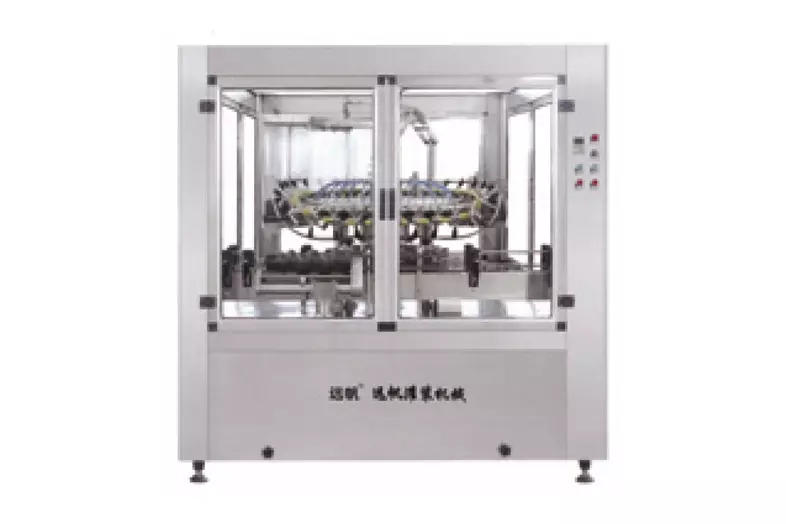
A flip-type rinser is defined by controlled bottle inversion. Bottles are located and held, turned mouth-down for an internal rinse and drain period, then returned upright for discharge. The published table lists 18- to 60-head models with output and utility consumption, but it does not state nozzle count, rinse stages, or a verified cleanliness result.
The working sequence normally comprises infeed positioning, gripping, inversion, internal rinsing, drainage, return to upright, and discharge. Neck finish, shoulder shape, center of gravity, and gripping surface therefore matter as much as overall diameter and height. The selected model's continuous or indexed motion, rinse time, and drain time should be documented in the technical agreement rather than inferred from the head count.
Inversion helps liquid leave an internally rinsed bottle. It does not by itself prove external washing, brushing, soaking, hot-water treatment, chemical disinfection, or a particular hygienic outcome; none of those functions is defined on the source page.
| Model | Number of heads | Output | Bottle height (mm) | Bottle diameter (mm) | Gas consumption (M³/h) | Water consumption (M³/h) | Total power (KW) | Dimensions (mm) |
|---|---|---|---|---|---|---|---|---|
| QCP-18H | 18 | 3000 | 160-320 | ∅60-∅100 | 0.7 | 0.7 | 2.25 | 1700×1750×2200 |
| QSP-30H | 30 | 5000 | 160-320 | ∅60-∅100 | 1.1 | 2.1 | 2.95 | 2060×2150×2200 |
| QSP-40H | 40 | 7000 | 160-320 | ∅60-∅100 | 1.3 | 2.9 | 4.1 | 2250×2600×2200 |
| QCP-48H | 48 | 10000 | 160-320 | ∅60-∅100 | 1.5 | 3.5 | 4.5 | 2550×2900×2200 |
| QSP-60H | 60 | 12000 | 160-320 | ∅60-∅100 | 2 | 4.4 | 5.2 | 3100×3470×2200 |
The published diameter and height ranges are a first screening tool, not confirmation that every bottle within them uses one gripper. The buyer should supply samples covering the heaviest and lightest bottles, short necks, unusual shoulders, and the glass bottles most likely to vary in wall thickness. The manufacturer uses those samples to define gripping position, guides, inversion clearance, dedicated format parts, and the changeover method.
Upstream equipment must present upright, uncapped empty bottles at a controlled rate, with enough accumulation to absorb machine stops. Downstream equipment must accept bottles that have returned upright but may retain some water, then provide any required drain time, air drying, filling, or corking. Conveyor elevation, flow direction, start/stop signals, and empty- or blocked-bottle logic belong in the line interface document.
Water and air consumption are listed by model, while supply pressure, quality, and connection sizes still require confirmation. The buyer normally brings compliant water, compressed air, power, and drainage to the agreed boundary; the manufacturer supplies machine connection data. Published machine dimensions do not include access for doors, servicing, changeovers, or infeed and discharge transitions.
Only water rinsing is supported by the published data. For hot water, filtered water, disinfectant, or another cleaning agent, the buyer provides composition, concentration, temperature, safety data, and discharge requirements. The manufacturer reviews compatibility of wetted components and seals. Media preparation and waste treatment must be separately listed if they are to be supplied.
Flip-type rinsers do not have one web price. Head count, bottle grippers, changeover sets, guarding and controls, electrical standard, line interfaces, spares, export packing, and commissioning scope all affect the total. The offer should name the exact model and sample list, then separate the main machine, format parts, control cabinet, tools, spares, documentation, FAT, packing, freight, field work, and training into clear inclusions and exclusions.
FAT should use the approved samples to check gripping, inversion, rinse, drainage, return to upright, changeover, bottle damage, and contracted line rate. Water and air conditions, test duration, counting method, and jam or breakage criteria are agreed before the run. SAT follows once site utilities and adjacent equipment are available and verifies interface signals, conveyor height, actual media, and sustained line operation.
The contract should define the warranty period and starting event, treatment of grippers and seals as wear parts, remote support, engineer day rates, travel responsibility, spare-part lead times, and operator training. Installation attendance or a specific cleaning result is not included merely because after-sales service is mentioned.
Use the bottle-washing range to compare mechanisms and the equipment parameter library to review adjacent machines. Line planning is covered in the filling-package overview and production-line overview; send bottle samples and quotation inputs through the contact page.
Recommended next step
Compare the right capacity, confirm the raw-material process and request a factory configuration before ordering.
Match cleaning, crushing, roasting, pressing, filtering and filling equipment.
Open pageReview preparation and pressing routes for seeds, nuts and specialty materials.
Open pageCompare price, capacity, process, operation and startup requirements.
Open pageSend the material, target output and destination for a matched factory quote.
Request quoteReview additional machine, process and buyer resources on hydraulic-oil-press.com.
Open website