Plan a complete production line
Match cleaning, crushing, roasting, pressing, filtering and filling equipment.
Open page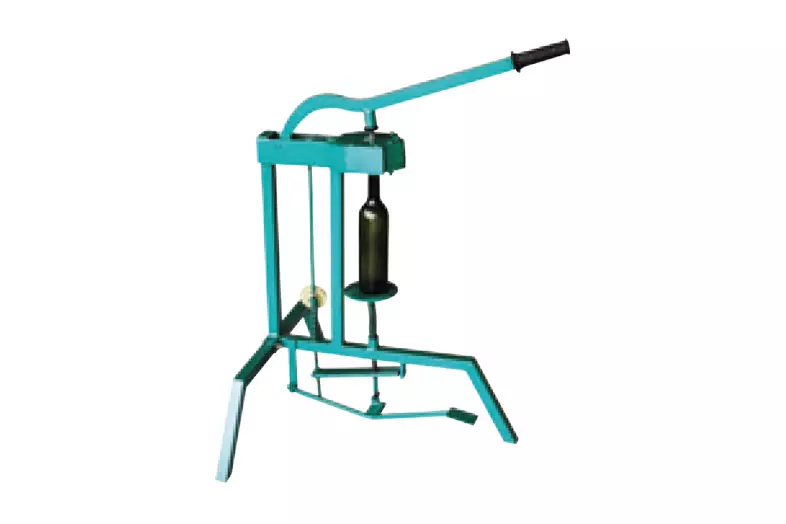
A manual corker is a one-bottle workstation for trials, short runs and products that do not justify continuous handling. Its value is direct operator control and a small operating boundary, not automatic transfer. The public information identifies cork-stoppered glass bottles as the application, but it does not establish a manual production rate or a universal bottle range.
Unless the offered drawing states otherwise, buy this category on the following responsibility split:
Each bottle requires pickup, positioning, cork placement, pressing, removal and a visual check. The practical pace therefore depends on the operator, bottle handling and the agreed cork fit. It should be measured with the buyer's samples, not calculated from the automatic DS figures shown elsewhere on this page. A tray or short accumulation area between filling and corking is normally more relevant than conveyor synchronization.
Send representative bottles and matching corks before ordering. Confirm bottle height and base stability, neck finish and opening, and cork type, diameter and length. Where several formats are planned, ask whether bottle supports, guides, height or stroke settings, or cork-contact parts require adjustment or replacement. The manufacturer should identify every included change part and any format that still requires a sample trial.
This unchanged table is public DS-series information. On a manual-machine purchase it must not be read as verified manual capacity, power or head configuration; the selected manual unit needs its own signed technical scope.
| Model | DS-1 | DS-4 | DS-6 |
|---|---|---|---|
| Number of plugging heads | 1 | 4 | 6 |
| Production capacity (bottles/hour) | 2500 | 4500 | 6000 |
| Complete machine power (kw) | 1.5 | 3 | 3 |
The layout should show whether the unit is bench- or floor-mounted, the operator side, safe hand clearance, bottle and cork staging, finished-bottle space and access for adjustment. Filled bottles can arrive from a batch filler or be taken from a line buffer, but a manual corker should not be treated as a synchronized filler interface. Cap shrinking is a separate downstream operation after the cork reaches the agreed seating position.
Do not assume that "manual" means no utilities. Ask the supplier to state whether the offered mechanism is fully mechanical or requires electricity, compressed air or another service, and to provide connection details when applicable.
For price comparison, request an itemized scope covering the main unit, mounting or stand, bottle support, supplied tools, format parts, initial wear or spare parts, manuals, export packing and after-sales contact. Installation, training, freight, taxes and site work should be marked included or excluded.
FAT should use the agreed sample bottle-and-cork combinations. Demonstrate loading, alignment, full insertion, bottle removal and repeated operation, then record the accepted seating condition and any operator adjustment. SAT should verify stable mounting, operator reach, local utilities if any, and the handoff from filling to corking and onward to cap shrinking. Do not add an hourly acceptance target unless both parties have defined and tested it.
Recommended next step
Compare the right capacity, confirm the raw-material process and request a factory configuration before ordering.
Match cleaning, crushing, roasting, pressing, filtering and filling equipment.
Open pageReview preparation and pressing routes for seeds, nuts and specialty materials.
Open pageCompare price, capacity, process, operation and startup requirements.
Open pageSend the material, target output and destination for a matched factory quote.
Request quoteReview additional machine, process and buyer resources on hydraulic-oil-press.com.
Open website