Plan a complete production line
Match cleaning, crushing, roasting, pressing, filtering and filling equipment.
Open page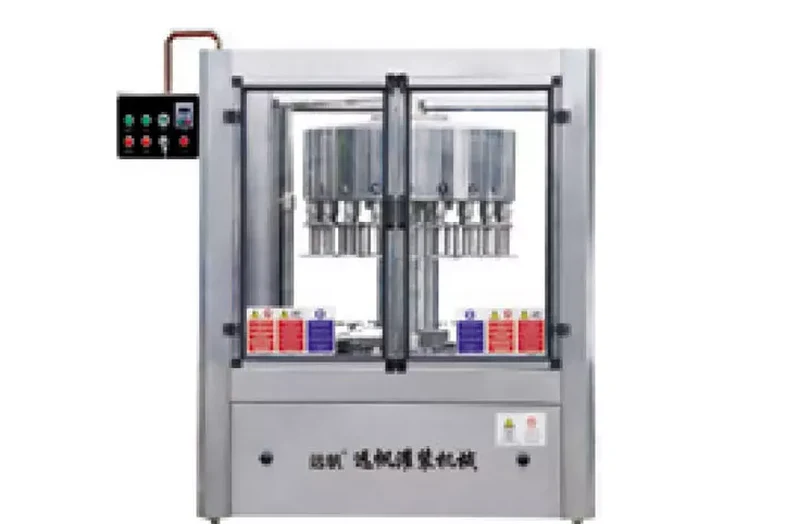
GFP-48H is the 48-head model with published references of 15,000 bottles/hour, 6 kW and 2800 x 2900 x 2200 mm. It is generally evaluated as the filling center of a broader packaging project, where closure supply, inspection, coding, packing and palletizing must be sized from the same accepted bottle rate.
Low-vacuum constant-level filling meters to a visible level rather than to mass. The published 15,000 bottles/hour figure is a reference condition, not a guaranteed complete-line result.
The table is retained exactly as published. Final compatibility, sustained output and supplied components must be stated in the technical quotation and acceptance protocol.
| Project | Parameters |
|---|---|
| Model | GFP-48H |
| Number of filling heads | 48 |
| Reference production | 15,000 bottles/hour |
| Total power | 6 kW |
| Overall dimensions | 2800×2900×2200 mm |
| Filling method | Low vacuum/constant level filling |
| Applicable liquids | Wine, rice wine, soy sauce, vinegar and other easily foaming liquids |
Before treating GFP-48H as a line centerpiece, prove the combination of rigid bottle, neck finish and non-carbonated liquid. Constant-level results depend on the valve interface and on product behavior at real temperature, including foam, dissolved gas and return flow. Named foods or beverages still require representative samples.
Route sparkling beverages, solids-bearing recipes, very viscous fluids, deformable containers and mass-based filling requirements to an alternative engineering study. The GFP reference table does not validate those duties.
A 48-head machine can only be judged within its packaging system. Counter totals, reduced interruption claims or container-handling claims are not acceptable assumptions without complete-line evidence.
At the 48-head reference level, downstream packing interruptions can propagate quickly. Define accumulation zones, reject lanes, coding data exchange and the response to palletizer or case-packer faults in the line functional description.
Connect the filling study to closure inspection, coding, case packing and palletizing. Define every conveyor zone, accumulation target, reject lane, data trigger and response to downstream faults. The process side needs an agreed tank, filtration, supply condition, return route, drainage and responsibility for cleaning circulation.
For product change, document recovery or disposal of residual liquid, rinse verification, seal compatibility and reassembly checks. For bottle change, list guides and lifting parts, storage racks and the qualification sample required before releasing the line.
The 48H RFQ should combine process and packaging data: each formulation and temperature, representative liquid volume, complete bottle and closure sets, fill-level rule, accepted line rate, pack pattern, coding and inspection need, layout, utilities, automation protocol, destination, commissioning plan and requested spare-parts horizon.
Agree on a representative continuous run and an accepted-bottle calculation. The protocol should record closure and packing interruptions, because filler counter totals alone do not demonstrate complete-line throughput.
Run FAT with enough closures and secondary packaging to expose downstream interaction. Calculate accepted complete-line output and log interruptions from coding, packing or palletizing instead of reporting only the filler count. Define sampling, level and foam limits, recovery cases and the SAT repeat list in advance.
Price evaluation should cover the entire agreed boundary. Separate the filler, product/vacuum package, format hardware, conveyors, inspection interfaces, control engineering, guards, documents, FAT consumables, export logistics, field work, training, warranty, start-up spares and continuing support. Only signed terms are commitments.
Develop a complete 48H packaging quotation. Provide product, bottle, closure and pack data on the project inquiry page.
Recommended next step
Compare the right capacity, confirm the raw-material process and request a factory configuration before ordering.
Match cleaning, crushing, roasting, pressing, filtering and filling equipment.
Open pageReview preparation and pressing routes for seeds, nuts and specialty materials.
Open pageCompare price, capacity, process, operation and startup requirements.
Open pageSend the material, target output and destination for a matched factory quote.
Request quoteReview additional machine, process and buyer resources on hydraulic-oil-press.com.
Open website