Plan a complete production line
Match cleaning, crushing, roasting, pressing, filtering and filling equipment.
Open page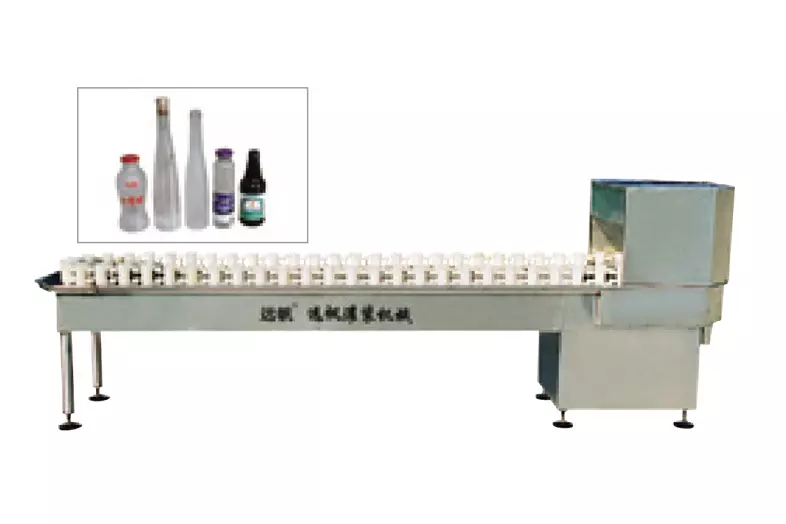
A chain-rail washer carries bottles along a straight path through the rinse zone. The source page specifies an outside spray, two inside rinses, operation from the available tap-water pressure, and a stainless steel water tank. It does not establish that the standard machine inverts bottles, uses brushes, heats water, or doses chemicals.
The rail, guides, and bottle supports keep each container in position while the spray pattern is applied. This arrangement is presented for new or returned bottles in different shapes and materials, particularly where a compact liquid plant needs one washer to cover several formats. Tall, lightweight, irregular, or unstable bottles still require a trial; broad format capability is not the same as universal handling.
The published process boundary is outside spraying plus two internal rinses. Returned bottles with dried product, oil, adhesive labels, or heavy storage contamination may need a separate prewash. Soaking, brushing, hot-water cleaning, disinfection, and multi-chemical stages must be specified as additional process requirements rather than assumed from the product name.
The buyer should submit physical samples or verified drawings for every bottle family, including the smallest, largest, tallest, lightest, and least stable examples. The condition of returned bottles and the expected residue should also be disclosed. Sample quantity, freight, customs formalities, delivery date, and disposal after testing are agreed before the trial.
The manufacturer then confirms rail pitch, guide width, support method, and spray alignment. The quotation should identify formats that share one setup, formats requiring dedicated parts, and the changeover procedure. No capacity, bottle-diameter range, or bottle-height range is published on this page, so those values must be confirmed for the proposed configuration.
The source refers to tap-water pressure but gives no inlet pressure, connection size, or drain requirement. The buyer provides water of the agreed quality, flow, and stable pressure to the defined battery limit, together with the external drain and floor drainage. The manufacturer supplies the machine-side connection schedule.
If filtered water, recirculated water, hot water, detergent, or disinfectant is required, the buyer identifies the medium, concentration, temperature, safety data, and discharge rules. The manufacturer can then review compatibility of wetted parts. Chemical preparation, wastewater treatment, and regulatory discharge compliance are outside the base machine unless the quotation expressly includes them.
A workable layout reserves the straight infeed and discharge runs, access to the water tank, an operator side, service clearance, and a drainage route. Conveyor height, flow direction, floor loading, and upstream/downstream transitions are frozen only after the samples and line drawing are approved.
There is no fixed purchase price on this page. Cost changes with the number of bottle formats, rail and guide arrangement, rinse zoning, electrical standard, line interfaces, spares, packing, and site-service scope. A commercial offer should itemize the main machine, stainless steel tank, format parts, controls, interface parts, commissioning spares, and packing. External conveyors, water treatment, plant piping, installation materials, freight, travel, commissioning, and training should be shown as included, optional, or excluded.
For a usable quote, provide the target line rate, bottle list, contamination condition, water data, plant layout, power supply, and adjacent equipment. The buyer owns the accuracy of those inputs and the site utilities; the manufacturer owns selection against the approved data and a clear supply boundary.
The FAT should run agreed representative bottles under the agreed water conditions and verify transport stability, outside spray, both internal rinse stages, drainage, changeover, and safety interlocks. If throughput is contractual, define the counting method, continuous run duration, and acceptance limit in advance. A vague statement such as "bottles are clean" is not enough; coverage, residual water, bottle damage, and jam criteria need an observable test method.
SAT takes place after site water, power, drainage, and adjoining conveyors are ready. It confirms interface height, line control, actual bottle transfer, and operation with the site utility. The contract should also state warranty start and duration, wear-part exclusions, remote support, field-service rates and travel, response method, spare-part pricing, and responsibility for failures caused by water quality, cleaning media, or misuse.
Compare the machine with the wider bottle-washing range and use the filling and packaging equipment library for line context. The filling-package overview and production-line overview cover adjacent equipment; submit samples and quote data through the contact page.
Recommended next step
Compare the right capacity, confirm the raw-material process and request a factory configuration before ordering.
Match cleaning, crushing, roasting, pressing, filtering and filling equipment.
Open pageReview preparation and pressing routes for seeds, nuts and specialty materials.
Open pageCompare price, capacity, process, operation and startup requirements.
Open pageSend the material, target output and destination for a matched factory quote.
Request quoteReview additional machine, process and buyer resources on hydraulic-oil-press.com.
Open website